I am just now leaving Tel Aviv after being here for 19 days. I have been so busy that I have even done more things than I had time to blog about. Now, it is back on the road. My rough itinerary looks like this: fly into Vienna, train to Prague (2 nights), train to Dresden, train to Berlin (2 nights), train to Amsterdam (4 nights). I hope to keep up from internet cafes.
Travel Tip #37: If you are all out of money, you don't need to exchange any currency when you leave the country.
Saturday, August 30, 2008


Through the Walls of Jericho
There are no walls around Jericho anymore. I probably would have known that if I had read The Bible. In fact, it seems quite isolated. From a distance it might seem to be just a tight community whose only predators are the rocks of the desert.
To get there, we hopped on a small bus at the bus station just outside the walls of Jerusalem's famous Old City. The signs inside this bus show the swooping script of Arabic words, not Hebrew's blocky characters, but that change doesn't really mean anything if you can't read either language. Only 15 minutes after leaving the city center, we had reached a Palestinian village that might be called a suburb. The streets are more clearly lined with trash here. On the side of the road, a dumpster's contents slowly burn. We are only here to transfer, but the driver of our service taxi is waiting to fill up with a few more passengers. Meanwhile, we sat in the car without air conditioning, while outside several men chain smoke their cigarettes in the shade, draped over plastic chairs. It is probably getting close to 100 degrees.
The city of Jericho is completely controlled by the Palestinian Authority. There is an Israeli military post about a mile outside the city's border, monitoring the road in and out. Other than that, however, the city's security and well-being are lead from within. Only a small percentage of the West Bank has this set-up, a step towards autonomy.
 Supposedly, Jericho is the oldest continuously-inhabited city on Earth, with records dating back 11,000 years. Today it has 20,000 residents.
When you are in a new and strange place, your eyes may strain to focus on anything that can spark a feeling of familiarity. Pulling into Jericho's main square, my eyes almost fell out of their sockets. A Palestinian kid riding a bicycle towards us was wearing a navy blue shirt with the gold, script lettering of CAL on the front. In a second he was gone, like maybe I hadn't even seen it.
We circled the entire town center and appeared to be the only tourists. It was a pretty regular market day it seemed. Parts of pigs hanging from butcher shop windows, boxes of plastic toys lining curbs, falafel boiling in large pans of oil. We stopped to eat at what looked like the nicest restaurant in town, which meant slight air-conditioning and tables off the street. Our waiter was a young guy about my age who spoke a sprinkling of key English words and smiled a lot. Our food was plentiful and very cheap and we made sure to leave a good tip. When we were leaving, our new friend shook my hand and asked where we were from and then if I maybe knew 50 Cent Rapper. I told him yes and that next time I would see him in California. He laughed and smiled at us as we left and then returned to work.
My dad and I discussed what it takes for a guy like that to get to America. I suppose the best case scenario is he has a relative who has already made it and maybe can send money or a job opportunity back home, but you'd probably have to be one in a million to get hooked up like that. I think maybe if he worked hard enough at the biggest business in town or a hotel, maybe he could afford to travel, if he could get through the roadblocks, much less all the red tape. Learning English is a must.
After another half-hour game of see how long the Americans sit in the taxi before they realize its much hotter inside than out, we were heading to the city limits. An Israeli guard took our passports and peeked inside the car and we were off, speeding at 140 kilometers per hour back towards Jerusalem.
I think what I learned from my brief foray into the West Bank was not that the Palestinians were living in hovels or prisons, or that they were being forced by Israeli soldiers to walk in straight lines and speak only when spoken to, but rather that their oppression takes more abstract forms. When you see the upscale malls and bustling intersections of any big Israeli city it is hard to imagine anyone utilizing the land any better. However, the Palestinian land issue is not a matter of who would use the area more efficiently or who would keep it cleaner, it is a matter of basic freedom. When the Palestinians are forced to live behind a wall or a fence, its more visible impact is the destruction of economic opportunities for individuals and the community, but its less obvious result lies only within the minds of its people. By telling someone to move away from their home and live in a confined space, you are refusing them the ability even to imagine a life beyond borders. After spending the last 4 weeks traveling halfway across the world, seeing a larger array of cultures than I ever have in my life, I realized how much I take this for granted. It pains me to think that this waiter, no matter how hard he may work, will be tied to the ground by some faceless exterior force. I have enjoyed my stay in Israel immensely and by meeting people and seeing the country top to bottom, many of my political preconceptions have changed for the better, but as long as Israel remains an occupying nation, I have no choice but to see it as an oppressor, a barrier to some kid's simple dreams.
To get there, we hopped on a small bus at the bus station just outside the walls of Jerusalem's famous Old City. The signs inside this bus show the swooping script of Arabic words, not Hebrew's blocky characters, but that change doesn't really mean anything if you can't read either language. Only 15 minutes after leaving the city center, we had reached a Palestinian village that might be called a suburb. The streets are more clearly lined with trash here. On the side of the road, a dumpster's contents slowly burn. We are only here to transfer, but the driver of our service taxi is waiting to fill up with a few more passengers. Meanwhile, we sat in the car without air conditioning, while outside several men chain smoke their cigarettes in the shade, draped over plastic chairs. It is probably getting close to 100 degrees.
The city of Jericho is completely controlled by the Palestinian Authority. There is an Israeli military post about a mile outside the city's border, monitoring the road in and out. Other than that, however, the city's security and well-being are lead from within. Only a small percentage of the West Bank has this set-up, a step towards autonomy.
 Supposedly, Jericho is the oldest continuously-inhabited city on Earth, with records dating back 11,000 years. Today it has 20,000 residents.
When you are in a new and strange place, your eyes may strain to focus on anything that can spark a feeling of familiarity. Pulling into Jericho's main square, my eyes almost fell out of their sockets. A Palestinian kid riding a bicycle towards us was wearing a navy blue shirt with the gold, script lettering of CAL on the front. In a second he was gone, like maybe I hadn't even seen it.
We circled the entire town center and appeared to be the only tourists. It was a pretty regular market day it seemed. Parts of pigs hanging from butcher shop windows, boxes of plastic toys lining curbs, falafel boiling in large pans of oil. We stopped to eat at what looked like the nicest restaurant in town, which meant slight air-conditioning and tables off the street. Our waiter was a young guy about my age who spoke a sprinkling of key English words and smiled a lot. Our food was plentiful and very cheap and we made sure to leave a good tip. When we were leaving, our new friend shook my hand and asked where we were from and then if I maybe knew 50 Cent Rapper. I told him yes and that next time I would see him in California. He laughed and smiled at us as we left and then returned to work.
My dad and I discussed what it takes for a guy like that to get to America. I suppose the best case scenario is he has a relative who has already made it and maybe can send money or a job opportunity back home, but you'd probably have to be one in a million to get hooked up like that. I think maybe if he worked hard enough at the biggest business in town or a hotel, maybe he could afford to travel, if he could get through the roadblocks, much less all the red tape. Learning English is a must.
After another half-hour game of see how long the Americans sit in the taxi before they realize its much hotter inside than out, we were heading to the city limits. An Israeli guard took our passports and peeked inside the car and we were off, speeding at 140 kilometers per hour back towards Jerusalem.
I think what I learned from my brief foray into the West Bank was not that the Palestinians were living in hovels or prisons, or that they were being forced by Israeli soldiers to walk in straight lines and speak only when spoken to, but rather that their oppression takes more abstract forms. When you see the upscale malls and bustling intersections of any big Israeli city it is hard to imagine anyone utilizing the land any better. However, the Palestinian land issue is not a matter of who would use the area more efficiently or who would keep it cleaner, it is a matter of basic freedom. When the Palestinians are forced to live behind a wall or a fence, its more visible impact is the destruction of economic opportunities for individuals and the community, but its less obvious result lies only within the minds of its people. By telling someone to move away from their home and live in a confined space, you are refusing them the ability even to imagine a life beyond borders. After spending the last 4 weeks traveling halfway across the world, seeing a larger array of cultures than I ever have in my life, I realized how much I take this for granted. It pains me to think that this waiter, no matter how hard he may work, will be tied to the ground by some faceless exterior force. I have enjoyed my stay in Israel immensely and by meeting people and seeing the country top to bottom, many of my political preconceptions have changed for the better, but as long as Israel remains an occupying nation, I have no choice but to see it as an oppressor, a barrier to some kid's simple dreams.
Thursday, August 28, 2008
The Golan
My dad and I just got back from a two-day trip to the Golan, a region in the northeastern corner of Israel. This area was captured by the Jews only four decades ago in the Six Day War and its ownership has been a matter of conflict with neighboring Syria ever since (Its Wikipedia page is even disputed). We had booked a tour in a small bus that carried us around to a handful of different cities and sights, from our home in Tel Aviv to a Kibbutz at the most northern reaches of Israel where would spend the night. Then, today we hit another set of points on the way back.
Our first stop was in the city of Nazareth (yes, of "Jesus of Nazareth" fame). This was also our first stop that had made an important appearance in the New Testament. It would not be our last, as it seems JC had booked the same tour with Israeli World Tour Group just two millennia ago, hitting all the same locations. For every place where the Bible says anyone committed any deed, there is a church built on top of that place, and in some places there are two or three churches that all claim to be built on top of that place. Not only that, but every church is not the original church, because every few centuries it gets knocked down in a war, so they pool money from Christians all over the world to build a new church on the ruins of the old.
Here in Nazareth, there is a well at which Mary was getting some water when she was told by the angel Gabe that she was pregnant with God's kid. So, inside this giant church there is a hole cut in the ground and there is the well. Christians from the Argentina to Zimbabwe are snapping pictures, praying, and buying postcards.
Next door is another church. This is where Joseph had his carpentry workshop. I think it was underground in a cave because we kept looking down this hole in the ground. I'm not sure really why he would have built furniture underground, but our tour guide just kept saying, "In the Christian tradition, Joseph worked in this cave...," like he was not going to admit its truth, but he wanted to explain why billions of people still thought it was true, even though it might look completely ridiculous to the heathens in the group. This church was called St. Joseph's. My dad and I wondered what Joseph had done to become a saint. We agreed that any guy who believes his virgin wife when she comes home and says she is going to have a baby, but it's okay because it's God's, was probably a saint.
We then stopped at a series of churches at places where Jesus had committed miracles, like the church of the stone where he stood to make bread and fishes for an entire community and the church outside the old synagogue where he brought back to life the daughter of a Roman soldier. It wasn't even lunchtime before I was getting warn out by the deadly combination of piety and humidity. I would say, however, one very interesting aspect of all these sites is that they never just represent one group, but really each site is an amalgamation of at least three. Some places will have a mosque built on top of a church built on top of a Roman palace built on top of a synagogue. (And to think it's heavy that the Bay St. shopping mall is built on top of an Ohlone Shellmound!) Also, this means that at every gift shop you can see menorahs and crucifixes sitting next to each other on the shelf. If only, religious harmony could exist as well in people as it does in trinkets.

 It is hot as hell (bite your tongue!) and I'm wondering why so much blood has been shed for this land while California sits miles away at a cool 70 degrees 365 days a year. But as we head further north, the golden brown of the desert that has been the theme color for every inch of this country starts to turn green. In the winter, they say it snows here. Tell that to my dehydrated camel. We drove through the Hula Valley, which looks a lot like Napa with big orchards stretching to the hills.
 The word peaceful might have floated in my head just as we drove up to the town where we would spend the night, but it was only fleeting. We stopped at a memorial for some of the first Jewish soldiers to die fighting the Arabs for this land in the 1920's. Only steps away was a smaller, more makeshift memorial for Israeli paratroopers who had been hit by a rocket on this spot just two years ago in the Second Lebanese War. There were a group of soldiers that had stopped by in there trucks to look. This was a very real example of how constant and immediate the fighting still is in this country.
 We were just a few kilometers from the border of Lebanon. Since going to Eilat a week and a half ago, I had now successfully traveled the entire length of Israel.
We spent the night at a hotel run by a Kibbutz called Kfar Gil'adi. This was one of those privatized kibbutzim, for sure. No commies here. Indoor pool, TV in every room, and an amazing buffet shown here:
 On our trip back we surveyed the area known specifically as the Golan Heights. Until 1967, Syrian troops used to shoot down at Jews in the valley from its strategically significant higher ground. Once it became part of Israel, Jews began to quickly settle and cultivate the region. There are rumors that the Israelis might give this region back to Syria in exchange for a peaceful border (similar to the one in Jordan), which would provide tourism for both countries through easy passage, as well as other considerations. However, there are cities like Katzrin, which was constructed completely within that short time period and already has about 8,000 people and very well could be Lafayette. The Israelis can build civilization like no other. My dad tells me that the Chinese have even hired them to start building cities from scratch in China. You could have a plot of barren land, but give it to the Israelis and it will have a shopping mall and a post office in no time. The reason for building like this is obvious. They are trying to settle the land to show that is Jewish. In some respects it is very good. I like visiting clean, well-organized cities, and their efficient use of the land's resources is incredible. However, this makes it very hard, when say, you might have to give the land back to another country in order to sign a peace agreement. This is true all over this country. Everywhere I go, I am surprised, yet very comforted by the Jewish cities. It is all very Western. But I can't help thinking that there is a back end to this. Is someone losing out, where the Israelis keep winning?
Tomorrow we are going to Jericho. This is one of the big cities in the Palestinian-occupied territories. I have only driven through the West Bank's peripheral regions, so this will be my first true glimpse on the other side of the wall. I felt if I was going to be in this country for 19 days I might as well see a place like this.
Our first stop was in the city of Nazareth (yes, of "Jesus of Nazareth" fame). This was also our first stop that had made an important appearance in the New Testament. It would not be our last, as it seems JC had booked the same tour with Israeli World Tour Group just two millennia ago, hitting all the same locations. For every place where the Bible says anyone committed any deed, there is a church built on top of that place, and in some places there are two or three churches that all claim to be built on top of that place. Not only that, but every church is not the original church, because every few centuries it gets knocked down in a war, so they pool money from Christians all over the world to build a new church on the ruins of the old.
Here in Nazareth, there is a well at which Mary was getting some water when she was told by the angel Gabe that she was pregnant with God's kid. So, inside this giant church there is a hole cut in the ground and there is the well. Christians from the Argentina to Zimbabwe are snapping pictures, praying, and buying postcards.
Next door is another church. This is where Joseph had his carpentry workshop. I think it was underground in a cave because we kept looking down this hole in the ground. I'm not sure really why he would have built furniture underground, but our tour guide just kept saying, "In the Christian tradition, Joseph worked in this cave...," like he was not going to admit its truth, but he wanted to explain why billions of people still thought it was true, even though it might look completely ridiculous to the heathens in the group. This church was called St. Joseph's. My dad and I wondered what Joseph had done to become a saint. We agreed that any guy who believes his virgin wife when she comes home and says she is going to have a baby, but it's okay because it's God's, was probably a saint.
We then stopped at a series of churches at places where Jesus had committed miracles, like the church of the stone where he stood to make bread and fishes for an entire community and the church outside the old synagogue where he brought back to life the daughter of a Roman soldier. It wasn't even lunchtime before I was getting warn out by the deadly combination of piety and humidity. I would say, however, one very interesting aspect of all these sites is that they never just represent one group, but really each site is an amalgamation of at least three. Some places will have a mosque built on top of a church built on top of a Roman palace built on top of a synagogue. (And to think it's heavy that the Bay St. shopping mall is built on top of an Ohlone Shellmound!) Also, this means that at every gift shop you can see menorahs and crucifixes sitting next to each other on the shelf. If only, religious harmony could exist as well in people as it does in trinkets.

 It is hot as hell (bite your tongue!) and I'm wondering why so much blood has been shed for this land while California sits miles away at a cool 70 degrees 365 days a year. But as we head further north, the golden brown of the desert that has been the theme color for every inch of this country starts to turn green. In the winter, they say it snows here. Tell that to my dehydrated camel. We drove through the Hula Valley, which looks a lot like Napa with big orchards stretching to the hills.
 The word peaceful might have floated in my head just as we drove up to the town where we would spend the night, but it was only fleeting. We stopped at a memorial for some of the first Jewish soldiers to die fighting the Arabs for this land in the 1920's. Only steps away was a smaller, more makeshift memorial for Israeli paratroopers who had been hit by a rocket on this spot just two years ago in the Second Lebanese War. There were a group of soldiers that had stopped by in there trucks to look. This was a very real example of how constant and immediate the fighting still is in this country.
 We were just a few kilometers from the border of Lebanon. Since going to Eilat a week and a half ago, I had now successfully traveled the entire length of Israel.
We spent the night at a hotel run by a Kibbutz called Kfar Gil'adi. This was one of those privatized kibbutzim, for sure. No commies here. Indoor pool, TV in every room, and an amazing buffet shown here:
 On our trip back we surveyed the area known specifically as the Golan Heights. Until 1967, Syrian troops used to shoot down at Jews in the valley from its strategically significant higher ground. Once it became part of Israel, Jews began to quickly settle and cultivate the region. There are rumors that the Israelis might give this region back to Syria in exchange for a peaceful border (similar to the one in Jordan), which would provide tourism for both countries through easy passage, as well as other considerations. However, there are cities like Katzrin, which was constructed completely within that short time period and already has about 8,000 people and very well could be Lafayette. The Israelis can build civilization like no other. My dad tells me that the Chinese have even hired them to start building cities from scratch in China. You could have a plot of barren land, but give it to the Israelis and it will have a shopping mall and a post office in no time. The reason for building like this is obvious. They are trying to settle the land to show that is Jewish. In some respects it is very good. I like visiting clean, well-organized cities, and their efficient use of the land's resources is incredible. However, this makes it very hard, when say, you might have to give the land back to another country in order to sign a peace agreement. This is true all over this country. Everywhere I go, I am surprised, yet very comforted by the Jewish cities. It is all very Western. But I can't help thinking that there is a back end to this. Is someone losing out, where the Israelis keep winning?
Tomorrow we are going to Jericho. This is one of the big cities in the Palestinian-occupied territories. I have only driven through the West Bank's peripheral regions, so this will be my first true glimpse on the other side of the wall. I felt if I was going to be in this country for 19 days I might as well see a place like this.
Friday, August 22, 2008
The Hashemite Kingdom of Jordan
After our departure from the Kibbutz, we took a bus down to the port city of Eilat. This city, at the very southernmost tip of Israel, owns a small portion of coastline on the Red Sea. The borders of Egypt and Jordan are only a few miles on either side and Saudi Arabia is only 40 miles down the road.
 My sister, the only one brave enough for the Red Sea.
We were only in Eilat long enough for two lemonades and a quick evaluation of our currency situation, but we spent it down at the beach watching big oil tankers come in to dock and bikini-clad Israelis smoking their cigarettes go out to sea. With its towering hotels framed by desert mountains and billboards galore, it reminded us all of Las Vegas. And on that note we flagged a taxi to take us to the Jordanian border.
The border crossing was quiet. Supposedly it is packed at 8am as people commute to work, but by 11 the station was isolated. At the passport window, a radio in the back played Phantom Planet's song "California." We pondered whether they play homeland anthems for everyone.

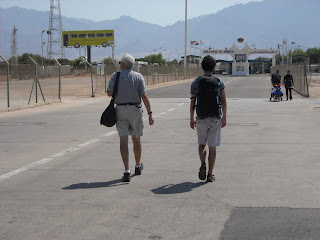 The history of the relationship between Israel and Jordan has been a tumultuous one, but since the signing of a peace treaty in 1994, it has been relatively stable. Because of Israel's geography, its language, and other more quirky characteristics of the country and its people, it has given me a taste of the foreign. Its culture is strange to me, but it is still a very Western place and after only a short period of time (especially in Tel Aviv), you can forget that you are in the distant Middle East. Entering the Arab nation of Jordan, it hit me that I might be leaving my comfort zone.
We are one of those families that despises the classification of the word tourist. If it's possible we desperately avoid going to "touristy places" and eating at "touristy restaurants." Several times on this trip, I have wondered the streets of a foreign city for much longer than necessary because I would be mortified to pull out and unfold a large map in public, thus exposing myself as just another lost American. However, on our trip through Jordan, we decided to bite the bullet and hire a travel agency to book transportation and beds for us. We didn't really have to worry about standing out as foreigners though. The brightness of our white skin and the bulge of our fanny packs could have stood out to even a blind local.
Our first stop was the ancient city of Petra. First settled by the Nabataeans in the 7th century B.C., this region was the center of the global spice trade for centuries. The walking tour of the site starts with a stroll at the bottom of a dry gorge. The walls, tall as skyscrapers, still have carvings from the ancient civilizations that called this their holy city.

Now, the most famous feature of the "rose-red city" is "The Treasury." If you have ever seen the third Indiana Jones with Harrison Ford and Sean Connery, then, one, congratulations on having great movie taste, and, two, you will for sure recognize this amazing structure built straight from the rock face.


 Future Album Cover
 Camels, just chilling.
We stayed a night in a hotel in the town just outside the archaeological site. The next day, we drove to Amman, the capital and biggest city of Jordan. 80% of the country is desert, so that is what we saw on this drive, until we reached the outskirts of Amman. The city is very busy with lots of cars, which all use their horns as if they were turning signals. Although the parts of the city that we saw were far from third-world status, there appeared to be many positive signs of development. Immediately outside our hotel window, they were building what will be the tallest building on Amman's skyline.
 Watch out King Abdallah, there's another monarch in town.
 In the morning, we left for the Allenby bridge, the border crossing over the Jordan river to enter the Israeli-occupied West Bank.
 My sister, the only one brave enough for the Red Sea.
We were only in Eilat long enough for two lemonades and a quick evaluation of our currency situation, but we spent it down at the beach watching big oil tankers come in to dock and bikini-clad Israelis smoking their cigarettes go out to sea. With its towering hotels framed by desert mountains and billboards galore, it reminded us all of Las Vegas. And on that note we flagged a taxi to take us to the Jordanian border.
The border crossing was quiet. Supposedly it is packed at 8am as people commute to work, but by 11 the station was isolated. At the passport window, a radio in the back played Phantom Planet's song "California." We pondered whether they play homeland anthems for everyone.

 The history of the relationship between Israel and Jordan has been a tumultuous one, but since the signing of a peace treaty in 1994, it has been relatively stable. Because of Israel's geography, its language, and other more quirky characteristics of the country and its people, it has given me a taste of the foreign. Its culture is strange to me, but it is still a very Western place and after only a short period of time (especially in Tel Aviv), you can forget that you are in the distant Middle East. Entering the Arab nation of Jordan, it hit me that I might be leaving my comfort zone.
We are one of those families that despises the classification of the word tourist. If it's possible we desperately avoid going to "touristy places" and eating at "touristy restaurants." Several times on this trip, I have wondered the streets of a foreign city for much longer than necessary because I would be mortified to pull out and unfold a large map in public, thus exposing myself as just another lost American. However, on our trip through Jordan, we decided to bite the bullet and hire a travel agency to book transportation and beds for us. We didn't really have to worry about standing out as foreigners though. The brightness of our white skin and the bulge of our fanny packs could have stood out to even a blind local.
Our first stop was the ancient city of Petra. First settled by the Nabataeans in the 7th century B.C., this region was the center of the global spice trade for centuries. The walking tour of the site starts with a stroll at the bottom of a dry gorge. The walls, tall as skyscrapers, still have carvings from the ancient civilizations that called this their holy city.

Now, the most famous feature of the "rose-red city" is "The Treasury." If you have ever seen the third Indiana Jones with Harrison Ford and Sean Connery, then, one, congratulations on having great movie taste, and, two, you will for sure recognize this amazing structure built straight from the rock face.


 Future Album Cover
 Camels, just chilling.
We stayed a night in a hotel in the town just outside the archaeological site. The next day, we drove to Amman, the capital and biggest city of Jordan. 80% of the country is desert, so that is what we saw on this drive, until we reached the outskirts of Amman. The city is very busy with lots of cars, which all use their horns as if they were turning signals. Although the parts of the city that we saw were far from third-world status, there appeared to be many positive signs of development. Immediately outside our hotel window, they were building what will be the tallest building on Amman's skyline.
 Watch out King Abdallah, there's another monarch in town.
 In the morning, we left for the Allenby bridge, the border crossing over the Jordan river to enter the Israeli-occupied West Bank.
Kibbutz/Desert Pictures
 Welcome to the Negev. Last stop for water: 1 hour ago.
 Looming from across the Jordanian border, might as well be the San Gabriel Mountains.
 Howard contemplates emigration.
 Inside the lush confines of Kibbutz Yotvata
Wednesday, August 20, 2008
The Kibbutz
We started our five-day journey on Friday morning from Tel Aviv. We took a train and a bus to make our way south through the country. It is not long before the lush trees and dense civilization make way for the sprawling desert. As far as the eye can see it is nothing but orange rock and sand. Soon we would grasp that this geographic style is a common theme in this part of the world. After deboarding the bus on the side of this desert highway, miles from the nearest CafeCafe (like a Starbucks) or theater showing of the ubiquitous Don't Mess with the Zohan, we entered the gate of Kibbutz Yotvata.
The Kibbutzim began to sprout up in this region decades before Israel's War of Independence in 1948. Generally started by adventurous European Jews, the Kibbutzim used the socialist theories of community living and applied them to the agricultural development needed for the large unpopulated areas of the country.
Growing up in Berkeley, the idea of picking up and moving away from your stuffy job in the States and going to work on a Kibbutz was kind of like how some people think of moving to Los Angeles to become an actor or writing the great American novel. For us socialist dreamers, the Kibbutz is the utopia that represents all that we wish we could do with our lives: work for our own food without relying on corporations to package and provide it for us, live exempt from the evils of our greenback slave drivers, and get to wear overalls. The knowledge that somewhere out there in the faraway desert there exists a community that works together and supports each other, gives us lefties a glimmer of hope that not all socialism ends up like Animal Farm.
Well, I suppose utopia is a bit strong, but after two days as guests in the community we were pretty impressed with the way things are in Yotvata. Once inside its borders, it is easy to forget the harshness of the terrain outside. 400 people live within its pleasant confines, enjoying a swimming pool, plenty of green lawns, a spacious dining hall and coffee parlor, and even a disco/gymnasium. Lucky for us, our first night coincided with an outdoor concert put on by members of the community with men, women, and children of all ages performed songs and poems under a full desert moon. I had been expecting to stay in a bunk, maybe next to a chicken coop or something along those lines, but our guest apartment had 2 bedrooms, a TV, a kitchen, and a refrigerator fully stocked with delicious chocolate milk. This was starting to not feel like the kind of socialism I had heard about. In fact, after hooking up with a big company that distributes its product, Yotvata has become the largest dairy in the entire country and is doing quite well.
There are some aspects of the system that I kind of thought were "cheating" as far as the original kibbutz model goes, but I suppose my ideals aren't exactly realistic in today's world. Everything seems to be a fair balance between practicality and some aspect of this great community concept. Almost all of the food we ate was brought in from outside (except the milk, of course), but it is all prepared and served by a Kibbutz member, a regular guy or gal who could very well be your neighbor. They hire outside help for big projects like construction, but someone from within does most every other job or helps out in some way or another with the production or just the general upkeep of the town: teachers, farmers, and even artists. Which brings me to the most radical piece of the organization: everyone gets paid the same amount. There are no salaries, except for a regular allowance that each Kibbutz member receives. This means that no money changes hands within the community.
The entire length of our stay, a consistent topic of conversation amongst our clan was The Fallacy, The Catch. What hidden attribute would prove the reason that everyone didn't live in a Kibbutz? If it was as pleasant and successful as this one seemed to be why was this not a more widespread form of living? I think the end result is that people generally don't want to have their lives governed by someone else. People like to make their own decisions about their money and their property and it is this reason that many Kibbutzim in Israel have already privatized, meaning that there are differential salaries and less community organization. Although it seemed like the people at Yotvata, and I agree, believe that privatization defeats the whole purpose of the community experiment. My dad was wise to note that, unlike the American communes of the sixties (of which he may or may not have lived in, depending on how much memory is resurrected), this commune is not driven by sex, drugs, or God. Going clean and secular, the goal of the community is solely the success and happiness of its participants and nothing else.
As we all left feeling both mentally and physically healthy, it appears this strategy is working well.
The Kibbutzim began to sprout up in this region decades before Israel's War of Independence in 1948. Generally started by adventurous European Jews, the Kibbutzim used the socialist theories of community living and applied them to the agricultural development needed for the large unpopulated areas of the country.
Growing up in Berkeley, the idea of picking up and moving away from your stuffy job in the States and going to work on a Kibbutz was kind of like how some people think of moving to Los Angeles to become an actor or writing the great American novel. For us socialist dreamers, the Kibbutz is the utopia that represents all that we wish we could do with our lives: work for our own food without relying on corporations to package and provide it for us, live exempt from the evils of our greenback slave drivers, and get to wear overalls. The knowledge that somewhere out there in the faraway desert there exists a community that works together and supports each other, gives us lefties a glimmer of hope that not all socialism ends up like Animal Farm.
Well, I suppose utopia is a bit strong, but after two days as guests in the community we were pretty impressed with the way things are in Yotvata. Once inside its borders, it is easy to forget the harshness of the terrain outside. 400 people live within its pleasant confines, enjoying a swimming pool, plenty of green lawns, a spacious dining hall and coffee parlor, and even a disco/gymnasium. Lucky for us, our first night coincided with an outdoor concert put on by members of the community with men, women, and children of all ages performed songs and poems under a full desert moon. I had been expecting to stay in a bunk, maybe next to a chicken coop or something along those lines, but our guest apartment had 2 bedrooms, a TV, a kitchen, and a refrigerator fully stocked with delicious chocolate milk. This was starting to not feel like the kind of socialism I had heard about. In fact, after hooking up with a big company that distributes its product, Yotvata has become the largest dairy in the entire country and is doing quite well.
There are some aspects of the system that I kind of thought were "cheating" as far as the original kibbutz model goes, but I suppose my ideals aren't exactly realistic in today's world. Everything seems to be a fair balance between practicality and some aspect of this great community concept. Almost all of the food we ate was brought in from outside (except the milk, of course), but it is all prepared and served by a Kibbutz member, a regular guy or gal who could very well be your neighbor. They hire outside help for big projects like construction, but someone from within does most every other job or helps out in some way or another with the production or just the general upkeep of the town: teachers, farmers, and even artists. Which brings me to the most radical piece of the organization: everyone gets paid the same amount. There are no salaries, except for a regular allowance that each Kibbutz member receives. This means that no money changes hands within the community.
The entire length of our stay, a consistent topic of conversation amongst our clan was The Fallacy, The Catch. What hidden attribute would prove the reason that everyone didn't live in a Kibbutz? If it was as pleasant and successful as this one seemed to be why was this not a more widespread form of living? I think the end result is that people generally don't want to have their lives governed by someone else. People like to make their own decisions about their money and their property and it is this reason that many Kibbutzim in Israel have already privatized, meaning that there are differential salaries and less community organization. Although it seemed like the people at Yotvata, and I agree, believe that privatization defeats the whole purpose of the community experiment. My dad was wise to note that, unlike the American communes of the sixties (of which he may or may not have lived in, depending on how much memory is resurrected), this commune is not driven by sex, drugs, or God. Going clean and secular, the goal of the community is solely the success and happiness of its participants and nothing else.
As we all left feeling both mentally and physically healthy, it appears this strategy is working well.
Thursday, August 14, 2008
Tel Aviv in a nutshell
I have spent the last two days walking this city up and down, but you only need a few hours in Tel Aviv to understand why this is such an easy place to be apolitical. The sea is warm, the food is plenty, the beaches are gorgeous, as are the women and the long boulevards. Welcome to Secular Israel.
Tomorrow we leave for the Kibbutz (read: collective community). And then over the border into Jordan. And then to the city of Jerusalem.
Tel Aviv might as well be another American city, except for the language and the fact that "everyone is Jewish" (a phrase my Dad will repeat constantly, each time to amaze himself). It looks as if my brief respite from the vagabond lifestyle is over, but I am excited to get myself back out into the unknown.
More stories on Tel Aviv to come, but for now my journey leads to the desert (cut to footage of camels and sandstorms...)
Tomorrow we leave for the Kibbutz (read: collective community). And then over the border into Jordan. And then to the city of Jerusalem.
Tel Aviv might as well be another American city, except for the language and the fact that "everyone is Jewish" (a phrase my Dad will repeat constantly, each time to amaze himself). It looks as if my brief respite from the vagabond lifestyle is over, but I am excited to get myself back out into the unknown.
More stories on Tel Aviv to come, but for now my journey leads to the desert (cut to footage of camels and sandstorms...)
Subscribe to:
Posts (Atom)